Monday, August 8, 2011

An Album Page of German "HyperInflation" Postage Stamps

Issued during a period of runaway monetary inflation between 1921 and 1923 in Germany.The Mark devalued so rapidly in these years that overprints were necessary to change values without printing more stamps  Some details of  these overprints issued to keep up with the devaluation of the German Mark are illustrated below


Sunday, August 7, 2011

3 More Pages of Soviet Russian Stamps

Page 4 of Russian Soviet Stamps

Page 5 of Russian Soviet Stamps
Page 6 of Russian Soviet Stamps


Soviet Russian Stamps-3 Pages from an Album

Page 1, 2 and 3 of Soviet Russian Stamps with details below.


Cochin Maharaja Stamps-Kerala Varma 3rd-Examples of 2 Dies in their Production


 Two dies were used in the production of  Varma the 3rd stamps. In Die 1, the back of the hat touching the frame/ Die 2 (a scarcer variety) with a small space between the hat and frame.


Friday, August 5, 2011

Two Old Album Pages of Indian Princely State Stamps

Two old album pages of Indian Princely States including

Cochin, Travancore, Hyderabad and Indore, with details below.


3 Portraits of African Women in Oil Paint

Below are three illustrations of African women painted in oil paint in 2008


Nazi German Stamps-Partial Set of "Hitler Heads"

Illustrated above is a partial set of Hitler head stamps. Issued from the 1940's throughout the Second World War until the final year of the war when the legend was changed from Deutches Reich to GrossDeutches Reich. Missing from the set are the 42pf and the 1, 2 and 5 Reichmarks issues. The detail of the 40 pf shows a nice example of the cd's used in the Nazi German postmark.


Liberian Postage Stamps-Commemorating a Presidential Visit

Commemorating President Tubman's European Tour (in 1956).Issued in 1958, frames engraved and vignettes lithographed by H.L. Peckmore & Sons, USA on unwatermarked paper, perforated 10¼. 7 stamps were issued. The set consisted of  3x 5 Cent issues in light brown, deep rose red and blue with 1 x 10 Cent issue in grey-black and 3 x 15 Cent issues in ultramarine, green and deep reddish violet.


Liberia's First Airmail Stamps


Engraved by Perkins, Bacon & Company, England on paper watermarked "Crosses and Circles"( perf 14.), On September 30, 1936, Liberia issued her first airmail set — showing a Ford Trimotor aeroplane landing in Liberia. The set consisted of a 1 Cent (yellow-green), a 2 C (scarlet), 3 C (violet), 4 C (orange), 5 C (greenish-blue), and 6 C (green) the full set is illustrated below. With a detail of the 6 Cent issue below the set.


Thursday, August 4, 2011

An Edwardian Postcard from Australia

An illustration of an Edwardian Postcard of (the now unknown) Miss Ada Reeve.

Posted in Brisbane on May 30th (no year date) and sent to Paddington in Sydney.


2 Old Postage Stamps of Sirmoor-Indian Princely States

Shown below are 2 stamps issued in Sirmoor between 1885 and 1896
They show a portrait of the Raja Shamsher Parkash (who died in 1898)
The Set consisted of values of 3 pies, 6 pies, 1 anna and 2 anna in orange,
blue-green, bright-blue and pink with some varieties in colour. There were
also some variations in printing the dots between the value and the
beginning and end of the words Sirmoor State Postage Stamp showing variation
In size and position. The examples illustrated here are of the large and even spaced
dot variety.


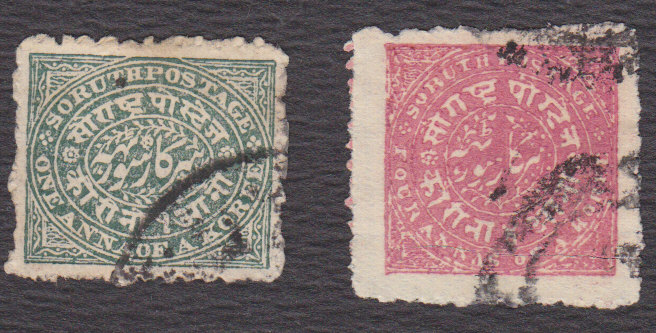
2 Old Postage Stamps of Soruth-Indian Princely States

Illustrated below are two stamps issued in the Feudatory Indian State of
Soruth. They are imperfs on laid paper issued between 1878 and 1886. The
only values issued were the 1 anna (green) and the 4 anna (vermilion) shown
here


Cochin Maharaja Stamps-Some Examples of Overprints

Some examples of the many varieties of overprint on Cochin Maharaja

stamps. With some detail illustrations of stamps shown below.


Georges de La Tour-The Art of Artificial Light-"The Newborn"


A follower of Caravaggio, Georges de La Tour took Caravaggio's lessons on light and made something wholly new. Not apparently a likable man but nevertheless a great artist, La Tour's mature works like "The Newborn" are marvels of clear artistic thinking and execution.
In nature (except at certain times of the day-like sunset) light is never clear cut. If you were to stand in a field on an average day light tends to be diffuse (even more so on cloudy or semi-cloudy days). This is because all surfaces reflect sunlight and therefore reflected lights will deflect any strong sensations of light coming from a single source. Painters,who use light effects in their work, must rather conceive the forms before them as struck by light from a single source rather than actually observe it. This is a difficult thing for most people who are just beginning to learn painting. This is one of the reasons why "still-life" is common starting point for teaching painting. The subject doesn't move and can be lit from a single light source. The problem of light is just as acute for gifted painters like La Tour as it is for anyone beginning to learn.
La Tour's solution is to make the light source artificial, using a single candle as the source of illumination in his mature work. This has the effect of reducing all reflected light to practically nothing, only just enough to light the extreme edges of his darkest areas. Not only does La Tour reduce the light but also the colour range he uses. La Tour keeps the local colours to whites, orange-reds, red-browns, browns and touches of black placed very carefully to maximise their reflectiveness to give the effect of brightly lit and deeply shadowed areas. The brightest white is placed in the garment of the woman holding and closest to the candle. The candle is shaded by the woman's hand increasing the contrast of very light against very dark. Again using white as the local colour, the next lightest area is the hood and shawl of the baby. This gives the effect of making the areas closest to the light source the brightest. As we move further away from the light source so the local colours are made less reflective, the head-dress of the woman holding the baby is also the darkest local colour she wears. La Tour's clarity of thought about his subject and it's possibilities does not conclude here. The woman holding the baby faces the viewer and therefore receives the most light. She also wears a richly coloured but simple robe without many creases Creases in her dress would create a too great variety of tones that would destroy the effect of her being bathed in light. The woman holding the candle however is turned in profile to the viewer. Her back is directly opposite the light source and therefore becomes one of the darkest areas of the painting. She also wears a dark-coloured robe, full of creases, allowing La Tour to paint her from dark to darker without losing a sense of her roundness of form. Similarly her head-dress is dark and textured while the head-dress of the woman holding the baby is smooth.
The extremely condensed nature of the light source also makes for subtle and imaginative touches that La Tour exploits fully. By holding the candle at the level of the baby each figure and its parts are lit at slightly different levels. For example, the baby is directly lit, the head of the woman holding the candle is lit from below, the hand she shades it with from directly opposite. These minor differences of relation to the light source and the placement of figures creating many subtle variations of lighter against darker throughout the work.
It is these elements that give La Tour's mature work their ambiguity of "realism" and "other-worldliness". His mastery of technique and observation provides the "realism". The conceptual mastery of the painterly elements the "otherworldliness" .Are we looking at an "ordinary" mother or the supernatural mother of the Bible ? We can be sure of one thing we are looking at the work of a great artist.

Wednesday, August 3, 2011

JAIPUR-Postage Stamps-Silver Jubilee of the Maharaja-1947

Illustrated below is a partial set of the stamps issued for the Silver Jubilee of the Maharaja of Jaipur Sawai Man Singh the second. The Maharaja came to the throne in 1922. The set consisted of a quarter anna (red-brown and green) half anna (green and violet), three quarter anna (black and lake), 1 a (red-brown and ultramarine), 2a (violet and scarlet), 3a (green and black), 4a (ultramarine and brown), 8a (vermilion and brown), 1 rupee (purple and green). Originally issued in 1947 the quarter anna, three quater anna, 3 anna and 1 rupee were issued in 1948. The detail is of the 8 anna coupling a portrait of the Maharaja with the state emblem of the Chariot of the Sun God.


Tuesday, August 2, 2011

Indian Convention States-Patiala-George the 5th Overprints Variety


Shown below is a block of 6 George the 5th postage stamps, half anna value Patiala officials with the overprint "Telephone Service"


Picasso-An Analysis of Les D'amoiselles D'Avignon in it's Historical Context


Les Demoiselles d'Avignon (The Young Ladies of Avignon ) is a large oil painting of 1907 by the Spanish artist Pablo Picasso (1881–1973). The work portrays five nude female prostitutes from a brothel on Carrer d'Avinyó (Avinyó Street) in Barcelona. The women are unflatteringly rendered with angular bodies. Two appear with African mask-like faces and three more with faces in the Early Iberian style of  Spain. Picasso here adapts a Primitivism and abandons use of modelling in favour of a flat, two-dimensional picture plane. In the painting Picasso was seeking a way in which figures could be simplified and made more structurally powerful and expressive.

The genesis of "D'amoiselles" was apparently difficult. In the year before the painting was finished  Picasso initiated a series of paintings and drawings that have subsequently become known as his "Negro Period".It was after this brief period that Picasso (who had already started  "D'amoiselles") returned to it and reworked two of the faces with African masks in mind. These faces, with flat ridged noses, sharp chins, small oval mouths and deleted ears have since been identified as characteristic of African masks of what was then called French Congo.


Finished in Paris during the summer of 1907, Picasso had created hundreds of sketches and studies in preparation for the final work. Picasso acknowledged the importance of Spanish art and Iberian sculpture as influences on the painting, but denied the influence of African masks. Some art historians remain skeptical about his denials. The sources of Picasso's influences are still debated. However from about 1906 African sculpture was beginning to interest many French painters. Vlaminck and Matisse were already beginning to form collections of African sculpture and in 1906 Derain ( an underrated artist) merged African motifs with influences from Cezanne in his painting "Bathers" It is also known that in the spring of 1907 Picasso visited the Musee Du Trocadero, with the poet Guillaume Appollinaire, where an exhibition of African sculpture from French Colonial Territories could be seen. According to this version of events the heads in "Damoiselles" were re-painted in Negro masks style with striations and distortions after this visit to the Trocadero. The last painting in which Picasso used striations was "Nude with Draperies" in 1907. Thereafter striations were dropped but simplified planes, now modelled in light and dark, were retained and the beginnings of Cubism were formed.
 
Although Picasso denied the influence of African sculpture on his work it is hard to see, given the time he was born into, how the influence could be ignored. Picasso was born in 1881 and French interest in Africa had begun in the late 1870's. Between 1875 and 1882 De-Brazza, a Frenchman, was exploring Africa in the area of what is now Gabon. The results of De-Brazza's exploration was the establishment of a French trading area on the north bank of the Congo river. Events in Europe were soon to make this trading area a base for colonial expansion.
Rising industrialism and commercialism, the search for new sources of raw materials and markets led to an economic race among the leading European nations. After about 1880 a movement was launched in France to push for economic and colonial expansion in Africa. Driven by fears of Germany, then expanding industrially at an unprecedented rate, a small group of French politicians and businessmen began a campaign to make France the leading political and economic power in Europe. By the end of the century French public opinion backed this view that only by large-scale colonisation could French markets expand and keep pace with Germany. With commercial interest established in Africa by the European powers a land grabbing race was on.


The dates of French acquisitions coincides very neatly with Picasso's early years. In 1881 Tunis was occupied, French Congo in 1885, Senegal , French Guinea and Ivory Coast in 1889, Algeria and Madagascar in 1890, Upper Senegal and Niger 1893 and 1898.
Picasso first arrived in Paris in 1900. Originally staying for about a month before returning to Spain he returned in the spring of 1901 to stay permanently. By 1906 Picasso was searching for an alternative way of painting to that of his "Blue" and "Rose" manner and began work on the "D'amoiselles".

If we view the historical times in which artists live  as a milieu from which artist may select or be confronted by those elements that shape their art Picasso's arrival in Paris is timely for the growing interest in Africa and its artifacts. (Spain is conspicuously absent from most of Africa). The appearance of African influences in "Modernism"  may be said to be a direct result of French colonialism. The collision of the two raises some interesting questions( if we perceive colonialism as "bad" and modern art as "good"). Did French artists exploit the art of French colonies in much the same way that colonies were exploited by moneyed and military groups of France ? Or did artists recognize the humanity in these by-products of colonialism, certainly the interest of French artists in African artifacts helped raise consciousness of it above anthropological curio. It is perhaps curious that aristocratic Britain (who dominated so much of Africa) never responded artistically to African art like Republican France.French artists never treated African art as "quaintly inferior" but recognized it as a means of expression and were willing to learn from it.

In fact the roots of interest in other cultures for French artists dates back to the beginnings of French expansion outside Europe. Napoleon's conquests in Egypt in 1798 introduced an "Oriental" fashion into
French art.  As French expansion continued into Africa the Far East and Oceania these influences grew and penetrated more deeply. Delacroix and Ingres both made use of Middle Eastern and North African motifs.
However both bring an essentially European sensibility and technique to "exotic" subjects. This relationship is somewhat changed in the work of Gauguin and Van Gogh ( who also saw France as his spiritual home). Van Gogh and Gauguin studied the art products of Japan and Cambodia less for their "picturesqueness" than for expressive qualities that they brought squarely into their own works. It is perhaps this tradition that Picasso and the French artists of the time inherit. The systemization of Cezanne coupled with the simplifications of the art of  non European cultures must certainly be counted in the development of Cubism.

Monday, August 1, 2011

Jaipur Sun God Chariot Postage Stamp-Officials

Jaipur  Sun God Chariot Stamps were also overprintedfor official use.Below are some examples with the 1 rupee overprinted in red in Hindi script.