Illustrated below is a page from an old album of Lebanese postage stamps. With two details showing close ups.
Tuesday, July 12, 2011
Friday, July 8, 2011
Two Russian Czarist Stamps And With Soviet Overprints
Here are 4 illustrations of stamps used during Czarist times and their overprinted versions during the early Soviet takeover of government before Soviet stamps were issued.
Thursday, July 7, 2011
Some French Colonial Stamps
I think some of the most visually interesting stamps are those produced in Europe during the colonial period in the late 19th and early 20th century.Colours are generally minimal, but striking,often using the colour wheel putting yellows against purples, reds against greens and oranges against blues. The designs are also very interesting, using local scenes and people rendered in elegant line drawings underlying the bold areas of colour with only one colour and the white of the paper for shading. Stamp borders are often patterned adding another area of interest to the stamp. The enlargements below also reveal the range of marks used to create areas of lighter or darker shades using shorter and longer lines or dots widely or densely spaced. The two Madagascan stamps enlarged below illustrate the techniques used to perfection. Some of the smaller illustrations can be enlarged by clicking on them. (back page to return to the blog) Below are some illustrations of some French colonial stamps from that period.
The two enlargments below are from the album page above
The enlargement below is from the album page above
Monday, July 4, 2011
Did I Buy an Original Gauguin at the Thrift Shop ?
As an habitual thrift shop customer I can never pass one without entering and having a look. The other day I went into a shop I frequent fairly regularly and it happened that a delivery of new/old things had just come in. I looked around and a painting caught my eye. At first I thought it was a print of a Gauguin but quickly realised it was an oil painting. As an admirer of Gauguin's work I have seen and studied more than a few both in original and in reproduction. This particular image I had never seen before and I thought perhaps a talented admirer of Gauguin had copied a detail from one of his works or had produced a more than fair semblance or pastiche based on their study of his work. I looked for a signature but couldn't find one.
The colour range seems to be fairly close to the colour range of Gauguin's painting and the brushwork too seems (with some reservations) close to the manner in which Gauguin applied paint. The psychological relationship of the figures is pure Gauguin with no connection to the viewer or each other.Each is wholly engrossed with their own occupation and the drawing is economical while perfectly descriptive in Gauguin's manner.
The aspects that bother me about it are the brushwork, some of the colour values and lack of finish. Some of the colour values are too weak or strong to give an overall unity. The darks of the background and palm shadows are too strong for the values of the foreground. Similarly the brushwork in some areas of the painting is confused and "muddy" or otherwise (as in the foreground) too broad. However all these points could be corrected with more work. There is an area in the foreground bushes that started light and was subsequently painted over in purple/grays. The dog appearing from the bushes in the foreground is also perhaps not realized with the kind of finish one would expect in a Gaugin but again more work would easily correct this.
A too oily application is also apparent with the oil running out of the paint and this has darkened with age giving an unaesthetic look to some of the surfaces.
Perhaps the strongest point mitigating against the painting being a genuine Gauguin is the support. This is a Grumbacher canvas board perhaps from the 1970's. However the grain of the canvas is quite coarse and this could be canvas or sacking (that Gauguin is known to have used) applied later to a canvas board.
Is it Gauguin on a bad day ? Or an unfinished painting by Gauguin ? Or pastiche by a talented admirer ?
Wednesday, June 22, 2011
Two Australian One Pound Banknotes of George 6th
The two illustrations shown here are the notes signed by Armitage and McFarlane these were issued between 1942 and 1948. The second were signed by Coombs/Watt these were issued between 1949 and 1951. The design for the Australian pound stayed the same but the Armitage/McFarlane issue has varieties of light and dark green. These have a Rennicks catalogue number of r30a and r30b.
The obverse shows the Australian Coat of Arms and a portrait of George the 6th.
The reverse shows a pastoral scene of tending sheep.
Note size is 154.94 mm in width and 81.28mm in height.
Paper weight is 77gsm.
Watermark is Captain Cook in oval. With ONE POUND behind each signature.
Mintage of Armitage/McFarlane was 320,592,000 and Coombs /Watt much lower at 179,000,000.
The serial numbers for Armitage/McFarlane were H,J,K or P over numerals running from H/0 000001 to H/99 1000000- J/0 000001 to K/96 1000000 then P/76 408001 to P/99 1000000.
Serial numbers foe Coombs/Watt were letters I,K and W over numerals running from I/0 000001 to I/99 1000000, K/97 000001 to K/99 1000000 then W/0 000001 to W/79 100000
![]()
The obverse shows the Australian Coat of Arms and a portrait of George the 6th.
The reverse shows a pastoral scene of tending sheep.
Note size is 154.94 mm in width and 81.28mm in height.
Paper weight is 77gsm.
Watermark is Captain Cook in oval. With ONE POUND behind each signature.
Mintage of Armitage/McFarlane was 320,592,000 and Coombs /Watt much lower at 179,000,000.
The serial numbers for Armitage/McFarlane were H,J,K or P over numerals running from H/0 000001 to H/99 1000000- J/0 000001 to K/96 1000000 then P/76 408001 to P/99 1000000.
Serial numbers foe Coombs/Watt were letters I,K and W over numerals running from I/0 000001 to I/99 1000000, K/97 000001 to K/99 1000000 then W/0 000001 to W/79 100000
Australian Pre-decimal Banknotes of the Reign of Queen Elizabeth 11
The pre-decimal 5 pound banknote of Queen Elizabeth the 2nd
On the obverse the note has a portrait of Sir John Franklin. On the reverse Australian Aboriginal artifacts and primary produce. The signatories were H.C. Coombs, Governor of the Australian Reserve Bank and Roland Wilson the Secretary to the Treasury.
The paper was 83gsm
Watermark : Captain Cook in the centre oval and FIVE behind each signature.
Mintage was 168,399,000
Serial numbers were : Prefix letters of TB,TC or TD over numeral and ran from Tb/41 120001 to TD/09 519000.
Australian Pre-decimal Banknote-During the reign of Queen Elizabeth 11
The Illustration below shows the Australian Pre-decimal One Pound Note. The obverse shows the Australian Coat of Arms and a portrait of Queen Elizabeth the 2nd. The reverse has two portraits one of Charles Sturt the other of Hamilton Hume.
The note size is 154.94 mm in width and 81.28 mm in height
Paper is 83 gsm
Signatories are also H.C. Coombs and Roland Wilson.
Watermark is Captain Cook in left oval with ONE POUND behind each signature.
The notes were printed in both emerald green and dark green varieties with a mintage for 500,544.000 for both types
Prefixes were HF,HG,HH and HI over numerals with the final number unknown
The note size is 154.94 mm in width and 81.28 mm in height
Paper is 83 gsm
Signatories are also H.C. Coombs and Roland Wilson.
Watermark is Captain Cook in left oval with ONE POUND behind each signature.
The notes were printed in both emerald green and dark green varieties with a mintage for 500,544.000 for both types
The reverse of the Reserve Bank pound note showed a major colour change mid-way through its 5 year production run. The shade was modified from dark to emerald green. The change occurred at some point during the printing of notes with the serial prefix of HI 06.
Prefixes were HF,HG,HH and HI over numerals with the final number unknown
Australian Pre-decimal Banknotes-Reign of Queen Elizabeth 11
The illustration shows the 10 Shilling Note.
the obverse of the Ten Shilliing note bears a portrait of the explorer Matthew Flinders, who gave his name to the Flinders Ranges. The reverse shows a picture of the old Australian Parliament House. Signatories are H.C. Coombs then Governor of the Reserve Bank of Australia and Roland Wilson Secretary to the Treasury.
The note width is 137.16 mm and height is 76.20mm
Paper wieght is 83 gsm
Watermark Captain Cook in profile with HALF behind each signature
237,548,000 were minted with the serial numbers AF,AG,AH over numerals from AF/20 000001 to AH 65 000000
Tuesday, June 21, 2011
The Stamps of Indian Princely States-Cochin Maharaja Stamps
Maharaja Portraits of Cochin (For the background contained in this post I am deeply indebted to Ron Rice who wrote a clear and detailed article on the history and stamp issues of the Maharajas of Cochin. The article can be found in the April 2001 (vol 2, no 2) issue of the Princely States Report. It can be read at http://www.princelystates.com/ArchivedFeatures/
The Maharaja Portraits: A Beginner's Guide to Cochin's Maharaja Stamps (Please note.....stamp illustrations can be enlarged by clicking on them)
Cochin was a small state on the Malabar coast, in the southwestern region of the Indian peninsula. Malayalam is the language of the region, and is used on the stamps of Cochin. However the stamps are bi-ligual and are printed in both Malayalam and English. For the advanced collector, it will be useful to learn to recognise Malayalam in order to identify errors that occur in the typesetting of the script.
Cochin had the highest literacy rate of any state during the British raj, and the people of Cochin were avid letter writers. Thus there are many covers and used stamps available for a reasonable cost. Mint stamps are much less common it seems that a very high percentage of stamps purchased were rapidly used. Many mint stamps catalogue at 10 or more times the used value. Some experts believe that the mint stamps are even scarcer than previously thought, giving them nice investment potential.
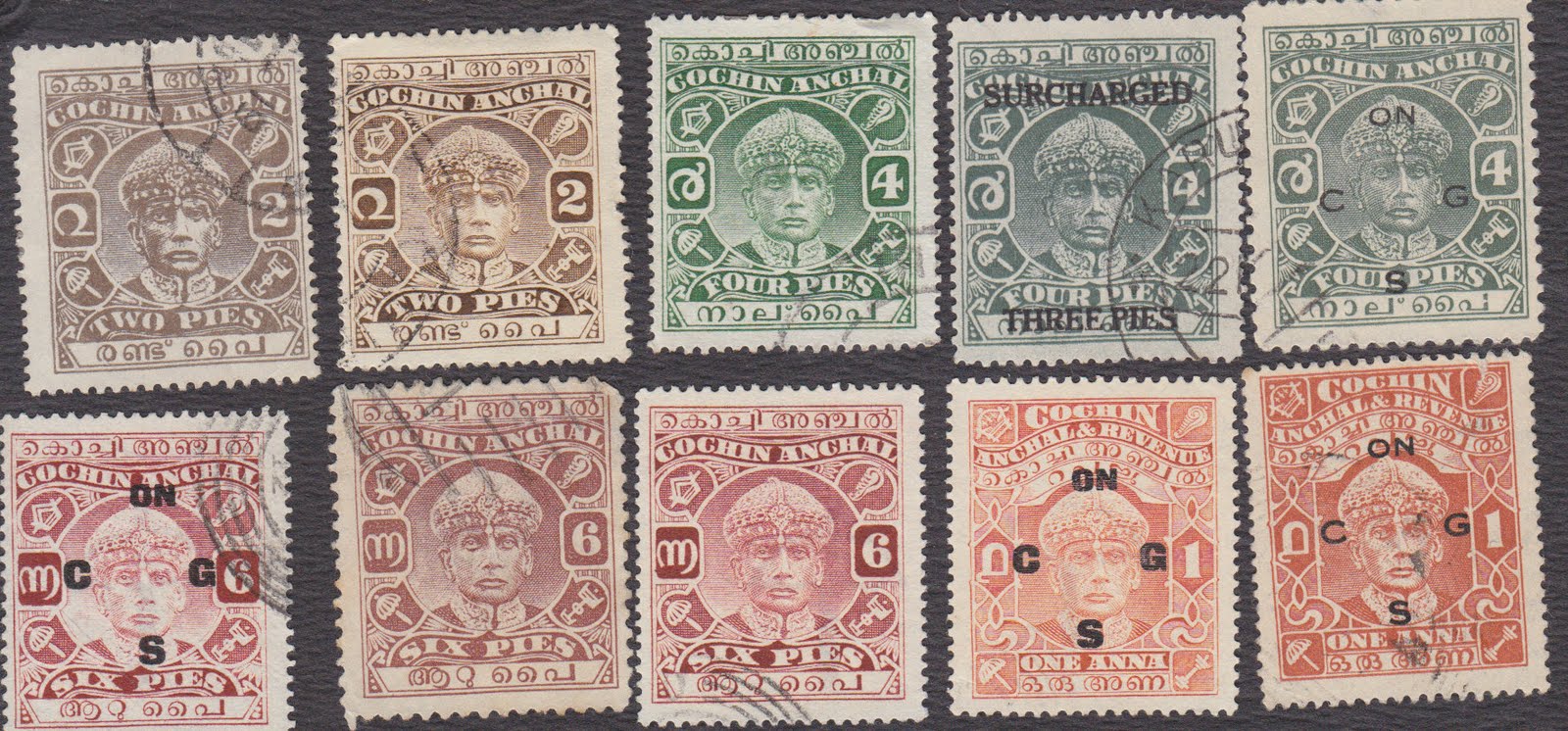
This article is focused on the series of Maharaja portraits that appeared on Cochin postage stamps from 1911 to 1950. During and prior to this period, stamps displaying state symbols and numerals were issued. 5 examples can be seen above
For those collectors who utilize the Scott catalogue, there are 84 major varieties of regular issues and 96 major varieties of official (overprinted) issues. These numbers increase to 112 and 116 respectively when one includes all the sub-varieties (represented by lower case letters such as 12a, 12b, ...). The Stanley Gibbons catalogue examines the portrait series in greater detail, resulting in 102 major varieties of regular issues and and 112 major varieties of official issues. Including sub-varieties, these numbers rise to 179 and 197 respectively. Thus, there are a total of 376 varieties of Maharajas on Cochin stamps in the most detailed mainstream catalogue. Additional varieties are described in advanced literature, and no doubt that there are varieties yet to be discovered.
Below is a brief account of each ruler, including those immediately before and after the period with which we are concerned. A quick note about the names of rulers: The title "Rama Varma" denotes the eldest son of a matriarch. A second son takes the name "Kerala Varma", and "Ravi Varma" denotes a third son. An additional title, "Goda Varma" for a fourth son, was used until the late 17th century.
H. H. Sir Sri Kerala Varma, Raja of Cochin, 1865-1895
Kerala Varma, also known as Chinga Masatrhil Theepta Vallia Thampuran, is not portrayed on the stamps of Cochin. He had a strong association with the British as was given the title K.C.I.E (Knight Commander of Most Eminent Order of the Indian Empire) prior to his ruler ship of Cochin. Fees for postage were introduced in Cochin in 1865, and the first adhesives of Cochin were issued during Kerala Varma's reign in 1892
H. H. Sir Sri Rama Varma I, Raja of Cochin, 1895-1914
Rama Varma I, also known as Ozinja Vallia Thampuran, resigned in 1914 due to differences with the British Empire. He is the first of six rulers portrayed on Cochin's postage stamps. A set of eight values (2p, 3p, 4p, 9p, 1a, 1 a, 2a, 3a) were recess printed by Perkins, Bacon & Co. from 1911 to 1913.
Nine stamps were overprinted for official use in 1913.
This group shows some of the varieties that were produced during his reign. With many being overprinted for government use both in red and black. The watermark is an umbrella, sometimes inverted or on the side left or right.
H. H. Sir Sri Rama Varma II, Raja/Maharaja of Cochin, 1914-1932
Rama Varma II was also known as Madrasil Theepeta Thampuran. In 1921 his title was changed from Raja to Maharaja, and all subsequent rulers were given this new title as well. A set of 11 values (2p, 4p, 6p, 8p, 9p, 10p, 1a, 1 a, 2a, 2 a, 3a) were recess printed by Perkins, Bacon & Co. from 1916 to 1930. The 1anna orange in this set was created for both Anchal and revenue use.
This group shows some of the overprints and the 1 anna issue for Anchal and revenue use
H. H. Sir Sri Rama Varma III, Maharaja of Cochin, 1932-1941
Rama Varma III was also known as Chowarayil Theepeta Thampuran. In 1938 Perkins, Bacon & Co. discontinued the contract with the state of Cochin, and an Indian firm began printing the stamps by lithographic process. Thus, two very different printings are found during the reign of Rama Varma III those beautifully recess printed by Perkins, Bacon & Co., and those of the less-attractive offset printed variety. It's important to learn to distinguish between these printings. The recess printed stamps are brighter, and the design appears slightly raised (looking at the back of the stamp, one can usually see an embossed image of the design). The litho, or offset, stamps are entirely flat, and the general appearance is dull in comparison. All Cochin stamps after 1938 were offset printed. This can be easily seen comparing these two 6 pies issues above.
In 1939, 1a stamps were overprinted "ANCHAL" for postal purposes (those not overprinted were used for revenue purposes). Here an understanding of the two printing types is useful. The recess printed 1a overprinted "ANCHAL" is quite common in used and mint condition, but the litho printed variety [Sc 59/SG 73] is rare in mint state. However, a slightly different "ANCHAL" was also printed on the litho, and it is very common in both used and unused condition. Here too the 1 anna issue is used for postal and revenue purposes. The 2 groups above show some of the varieties of overprinting/surcharges and off set/litho variations in these issues
H. H. Sir Sri Kerala Varma II, Maharaja of Cochin, 1941-1943
Kerala Varma II, also known as Medukan Thampuran, was the younger brother of the previous ruler. His crude portrait on stamps is rather unfortunate. Kerala Varma II only ruled for two years. His stamps were printed in 1943, then overprinted for official use in 1944.
Six values (2p, 4p, 6p, 9p, 1a, 2 a) were offset printed by The Associated Printers. The 2p, 4p, and 1a values were first printed on paper with the umbrella watermark of the earlier stamps. A new watermark was later introduced and used with all six values in this set. The new watermark had a large design, resulting in stamps that show various parts or none of the watermark. Among the umbrella watermarked varieties, the 4p green [Sc 64a/SG 85b] is rare, and the 1a brown-orange [Sc 67a/SG 85c] is somewhat scarce. The 1a brown orange with the larger watermark [Sc 67/SG 90] is also scarce. Watch out for forged cancels on the 1a it was primarily used fiscally and authentic postal cancels are seldom encountered. The other values on the larger watermark are fairly easy to obtain. Nine varieties of surcharge overprints are found on the regular issues of Kerala Varma II all are common, but expect to pay a bit more for the 3p on 4p green [Sc 69a/SG 92].
Six values were overprinted for official use the 2p and 9p were never overprinted, and additional 2a and 3a values are only found with overprints. In this basic set of officials, all but one are easy to obtain. The 1a brown-orange [SG O70] (not listed in Scott) is somewhat scarce in used condition and very rare in mint state.
The group above shows some of the surcharges and overprints including a 3 pies on 6 joined pair. Now all litho printed issues.
a small group of 2/2 and a quarter/and 3 anna values
H. H. Sir Sri Ravi Varma, Maharaja of Cochin, 1943-46
Ravi Varma was the younger brother of the previous ruler, who was in turn the younger brother of the ruler before him. Like the previous ruler, his reign was short only three years. From 1944 to 1948 three values (9p, 1a3p, 1a9p) were offset printed by The Associated Printers. In this set, the Maharaja is shown with head turned slightly toward the right side of the stamp design.
This group shows the original issue with a shade variety in the 9 pies issue
From 1946 to 1948, eight values (2p, 3p, 4p, 6p, 9p, 1a, 2a, 3a) were printed where the Maharaja's head is turned slightly toward the left side of the design. The first set of three is fairly common. The second set of eight in used condition is within the reach of many collectors, but expect to pay a bit more for the scarce 4p grey-green [Sc 83A/SG 103] and the 1a orange [SC 86/SG 106]. This set in mint condition is rare and valuable.
In 1949, five surcharges were overprinted on the stamps of Ravi Varma 6p (on 1a3p) and 1a (on 1a9p) with head facing right, and 3p (on 9p), 6p (on 1a3p), and 1a (on 1a9p) with head facing left. The basic set is reasonably priced, but some valuable sub-varieties are catalogued. Later in the same year, a different type of surcharge was introduced 6p (on 1a) and 9p (on 1a) with head facing left. These are scarce in mint state and even more scarce in used condition.
The three values of the first type (head facing right) were overprinted for official use, and the basic varieties are all common in both used and unused condition. The 1a9p value is also commonly found surcharged 1a. Nine values of the second type (head facing left) are overprinted for official use the 2p and 1a were not overprinted, and additional 1a3p, 1a9p, and 2 a values are only found with overprints. The 1a9p value, as with the other type, is found surcharged 1a, though it is less common. All of Ravi Varma's official issues are within a reasonable price range, making them a nice series for the beginning to intermediate collector.
H. H. Sir Sri Kerala Varma III, Maharaja of Cochin, 1946-1948
Kerala Varma III, also known as Ikyakeralam Thampuran, was the last Cochin ruler to be portrayed on stamps. Like the two rulers before him, his reign was very short only two years. Eight values (2p, 3p, 4p, 6p, 9p, 2a, 3a, 3a4p) were offset printed by The Associated Printers of Madras from 1948-1950. All but one in the basic set are common in used condition the 3a4p violet [Sc 97/SG 116] is quite rare. Several values in this set are scarce in mint state. Three common surcharges are found two types of 3p (on 9p) and a 6p (on 9p). Some of the sub-varieties of these surcharges are scarce to very rare.
Eight values were overprinted for official use in 1949 the 2p was not overprinted, and an additional 2 a value was only issued with the official overprint. This complete set is reasonably priced in both used and mint state. In this same year, three surcharges were overprinted on officials 6p (on 3p), 9p (on 4p) and 3p (on 9p). The basic varieties are common, but several scarce sub-varieties are catalogued.
A group showing overprint varieties of the last Maharaja's issues
In 1949, two new stamp designs were introduced that are unlike any others in the Maharaja portrait series. They are horizontal in format, and the ruler's image is reduced to the upper right corner. The main part of the design is pictorial, showing Chinese fishing nets on one (2a value) and a Dutch palace on the other (2 a value). Both are common in used and unused condition. They were not surcharged or overprinted for official use.
H. H. Sir Sri Rama Varma IV, Maharaja of Cochin, 1948-1949
Rama Varma IV, also known as Parikshith Thampuran, was the last official ruler of the Cochin Empire. He is not portrayed on the stamps of the state. A few stamps depicting the former ruler were still in production during his reign. In 1949 Travancore and Cochin merged and his kingdom came to an end. He ruled for just one year, but was recognized as the Velliya Thampuran of Cochin until his death in 1964. Under the State Reorganization Act of 1956, Travancore-Cochin lost a few districts and gained a few others, to form a new state, Kerala, which is still in existence today.
There is a simple, yet powerful elegance to the Maharaja portraits of Cochin. When assembled on album pages by ruler, value, color, or just about any other arrangment, they make for a visually stunning display. There is a substantial amount of material available for the low-budget collector and just as many rare varieties for wealthy philatelists. I recommend consulting the Stanley Gibbons catalogue for more information about sub-varieties. Those wishing to learn about more advanced literature on the subject may contact (Ron Rice) at
The Maharaja Portraits: A Beginner's Guide to Cochin's Maharaja Stamps (Please note.....stamp illustrations can be enlarged by clicking on them)
Cochin was a small state on the Malabar coast, in the southwestern region of the Indian peninsula. Malayalam is the language of the region, and is used on the stamps of Cochin. However the stamps are bi-ligual and are printed in both Malayalam and English. For the advanced collector, it will be useful to learn to recognise Malayalam in order to identify errors that occur in the typesetting of the script.
Cochin had the highest literacy rate of any state during the British raj, and the people of Cochin were avid letter writers. Thus there are many covers and used stamps available for a reasonable cost. Mint stamps are much less common it seems that a very high percentage of stamps purchased were rapidly used. Many mint stamps catalogue at 10 or more times the used value. Some experts believe that the mint stamps are even scarcer than previously thought, giving them nice investment potential.
This article is focused on the series of Maharaja portraits that appeared on Cochin postage stamps from 1911 to 1950. During and prior to this period, stamps displaying state symbols and numerals were issued. 5 examples can be seen above
For those collectors who utilize the Scott catalogue, there are 84 major varieties of regular issues and 96 major varieties of official (overprinted) issues. These numbers increase to 112 and 116 respectively when one includes all the sub-varieties (represented by lower case letters such as 12a, 12b, ...). The Stanley Gibbons catalogue examines the portrait series in greater detail, resulting in 102 major varieties of regular issues and and 112 major varieties of official issues. Including sub-varieties, these numbers rise to 179 and 197 respectively. Thus, there are a total of 376 varieties of Maharajas on Cochin stamps in the most detailed mainstream catalogue. Additional varieties are described in advanced literature, and no doubt that there are varieties yet to be discovered.
Below is a brief account of each ruler, including those immediately before and after the period with which we are concerned. A quick note about the names of rulers: The title "Rama Varma" denotes the eldest son of a matriarch. A second son takes the name "Kerala Varma", and "Ravi Varma" denotes a third son. An additional title, "Goda Varma" for a fourth son, was used until the late 17th century.
H. H. Sir Sri Kerala Varma, Raja of Cochin, 1865-1895
Kerala Varma, also known as Chinga Masatrhil Theepta Vallia Thampuran, is not portrayed on the stamps of Cochin. He had a strong association with the British as was given the title K.C.I.E (Knight Commander of Most Eminent Order of the Indian Empire) prior to his ruler ship of Cochin. Fees for postage were introduced in Cochin in 1865, and the first adhesives of Cochin were issued during Kerala Varma's reign in 1892
H. H. Sir Sri Rama Varma I, Raja of Cochin, 1895-1914
Rama Varma I, also known as Ozinja Vallia Thampuran, resigned in 1914 due to differences with the British Empire. He is the first of six rulers portrayed on Cochin's postage stamps. A set of eight values (2p, 3p, 4p, 9p, 1a, 1 a, 2a, 3a) were recess printed by Perkins, Bacon & Co. from 1911 to 1913.
Nine stamps were overprinted for official use in 1913.
This group shows some of the varieties that were produced during his reign. With many being overprinted for government use both in red and black. The watermark is an umbrella, sometimes inverted or on the side left or right.
H. H. Sir Sri Rama Varma II, Raja/Maharaja of Cochin, 1914-1932
Rama Varma II was also known as Madrasil Theepeta Thampuran. In 1921 his title was changed from Raja to Maharaja, and all subsequent rulers were given this new title as well. A set of 11 values (2p, 4p, 6p, 8p, 9p, 10p, 1a, 1 a, 2a, 2 a, 3a) were recess printed by Perkins, Bacon & Co. from 1916 to 1930. The 1anna orange in this set was created for both Anchal and revenue use.
This group shows some of the overprints and the 1 anna issue for Anchal and revenue use
H. H. Sir Sri Rama Varma III, Maharaja of Cochin, 1932-1941
Rama Varma III was also known as Chowarayil Theepeta Thampuran. In 1938 Perkins, Bacon & Co. discontinued the contract with the state of Cochin, and an Indian firm began printing the stamps by lithographic process. Thus, two very different printings are found during the reign of Rama Varma III those beautifully recess printed by Perkins, Bacon & Co., and those of the less-attractive offset printed variety. It's important to learn to distinguish between these printings. The recess printed stamps are brighter, and the design appears slightly raised (looking at the back of the stamp, one can usually see an embossed image of the design). The litho, or offset, stamps are entirely flat, and the general appearance is dull in comparison. All Cochin stamps after 1938 were offset printed. This can be easily seen comparing these two 6 pies issues above.
In 1939, 1a stamps were overprinted "ANCHAL" for postal purposes (those not overprinted were used for revenue purposes). Here an understanding of the two printing types is useful. The recess printed 1a overprinted "ANCHAL" is quite common in used and mint condition, but the litho printed variety [Sc 59/SG 73] is rare in mint state. However, a slightly different "ANCHAL" was also printed on the litho, and it is very common in both used and unused condition. Here too the 1 anna issue is used for postal and revenue purposes. The 2 groups above show some of the varieties of overprinting/surcharges and off set/litho variations in these issues
H. H. Sir Sri Kerala Varma II, Maharaja of Cochin, 1941-1943
Kerala Varma II, also known as Medukan Thampuran, was the younger brother of the previous ruler. His crude portrait on stamps is rather unfortunate. Kerala Varma II only ruled for two years. His stamps were printed in 1943, then overprinted for official use in 1944.
Six values (2p, 4p, 6p, 9p, 1a, 2 a) were offset printed by The Associated Printers. The 2p, 4p, and 1a values were first printed on paper with the umbrella watermark of the earlier stamps. A new watermark was later introduced and used with all six values in this set. The new watermark had a large design, resulting in stamps that show various parts or none of the watermark. Among the umbrella watermarked varieties, the 4p green [Sc 64a/SG 85b] is rare, and the 1a brown-orange [Sc 67a/SG 85c] is somewhat scarce. The 1a brown orange with the larger watermark [Sc 67/SG 90] is also scarce. Watch out for forged cancels on the 1a it was primarily used fiscally and authentic postal cancels are seldom encountered. The other values on the larger watermark are fairly easy to obtain. Nine varieties of surcharge overprints are found on the regular issues of Kerala Varma II all are common, but expect to pay a bit more for the 3p on 4p green [Sc 69a/SG 92].
Six values were overprinted for official use the 2p and 9p were never overprinted, and additional 2a and 3a values are only found with overprints. In this basic set of officials, all but one are easy to obtain. The 1a brown-orange [SG O70] (not listed in Scott) is somewhat scarce in used condition and very rare in mint state.
The group above shows some of the surcharges and overprints including a 3 pies on 6 joined pair. Now all litho printed issues.
a small group of 2/2 and a quarter/and 3 anna values
H. H. Sir Sri Ravi Varma, Maharaja of Cochin, 1943-46
Ravi Varma was the younger brother of the previous ruler, who was in turn the younger brother of the ruler before him. Like the previous ruler, his reign was short only three years. From 1944 to 1948 three values (9p, 1a3p, 1a9p) were offset printed by The Associated Printers. In this set, the Maharaja is shown with head turned slightly toward the right side of the stamp design.
This group shows the original issue with a shade variety in the 9 pies issue
From 1946 to 1948, eight values (2p, 3p, 4p, 6p, 9p, 1a, 2a, 3a) were printed where the Maharaja's head is turned slightly toward the left side of the design. The first set of three is fairly common. The second set of eight in used condition is within the reach of many collectors, but expect to pay a bit more for the scarce 4p grey-green [Sc 83A/SG 103] and the 1a orange [SC 86/SG 106]. This set in mint condition is rare and valuable.
In 1949, five surcharges were overprinted on the stamps of Ravi Varma 6p (on 1a3p) and 1a (on 1a9p) with head facing right, and 3p (on 9p), 6p (on 1a3p), and 1a (on 1a9p) with head facing left. The basic set is reasonably priced, but some valuable sub-varieties are catalogued. Later in the same year, a different type of surcharge was introduced 6p (on 1a) and 9p (on 1a) with head facing left. These are scarce in mint state and even more scarce in used condition.
The three values of the first type (head facing right) were overprinted for official use, and the basic varieties are all common in both used and unused condition. The 1a9p value is also commonly found surcharged 1a. Nine values of the second type (head facing left) are overprinted for official use the 2p and 1a were not overprinted, and additional 1a3p, 1a9p, and 2 a values are only found with overprints. The 1a9p value, as with the other type, is found surcharged 1a, though it is less common. All of Ravi Varma's official issues are within a reasonable price range, making them a nice series for the beginning to intermediate collector.
H. H. Sir Sri Kerala Varma III, Maharaja of Cochin, 1946-1948
Kerala Varma III, also known as Ikyakeralam Thampuran, was the last Cochin ruler to be portrayed on stamps. Like the two rulers before him, his reign was very short only two years. Eight values (2p, 3p, 4p, 6p, 9p, 2a, 3a, 3a4p) were offset printed by The Associated Printers of Madras from 1948-1950. All but one in the basic set are common in used condition the 3a4p violet [Sc 97/SG 116] is quite rare. Several values in this set are scarce in mint state. Three common surcharges are found two types of 3p (on 9p) and a 6p (on 9p). Some of the sub-varieties of these surcharges are scarce to very rare.
Three of the 2 pies issue of H H Sir Sri Kerala Varma 111 showing shades and die variations.
Two dies were also used in the production of Varma the 3rd stamps. In Die 1, the back of the hat touching the frame/ Die 2 (a scarcer variety) with a small space between the hat and frame.
A group showing overprint varieties of the last Maharaja's issues
In 1949, two new stamp designs were introduced that are unlike any others in the Maharaja portrait series. They are horizontal in format, and the ruler's image is reduced to the upper right corner. The main part of the design is pictorial, showing Chinese fishing nets on one (2a value) and a Dutch palace on the other (2 a value). Both are common in used and unused condition. They were not surcharged or overprinted for official use.
H. H. Sir Sri Rama Varma IV, Maharaja of Cochin, 1948-1949
Rama Varma IV, also known as Parikshith Thampuran, was the last official ruler of the Cochin Empire. He is not portrayed on the stamps of the state. A few stamps depicting the former ruler were still in production during his reign. In 1949 Travancore and Cochin merged and his kingdom came to an end. He ruled for just one year, but was recognized as the Velliya Thampuran of Cochin until his death in 1964. Under the State Reorganization Act of 1956, Travancore-Cochin lost a few districts and gained a few others, to form a new state, Kerala, which is still in existence today.
There is a simple, yet powerful elegance to the Maharaja portraits of Cochin. When assembled on album pages by ruler, value, color, or just about any other arrangment, they make for a visually stunning display. There is a substantial amount of material available for the low-budget collector and just as many rare varieties for wealthy philatelists. I recommend consulting the Stanley Gibbons catalogue for more information about sub-varieties. Those wishing to learn about more advanced literature on the subject may contact (Ron Rice) at
Stamps of Indian Convention States-Early overprints on Victoria Heads
The illustration below shows some of the variety of overprints on the early stamps over Indian Convention States. Examples are of Jind, Nabha, Chamba and Gwalior. Early overprints were in red or black often as a "halo" around the head of Victoria. Many must have been done by hand since the positions of the overprint can vary considerably as the Jind examples show. The Gwalior overprints also show some variation, sometimes written in Hindi script only other times in English and Hindi and with variations in position.
Monday, June 20, 2011
Postage Stamps of Indian Princely States-Kishangarh
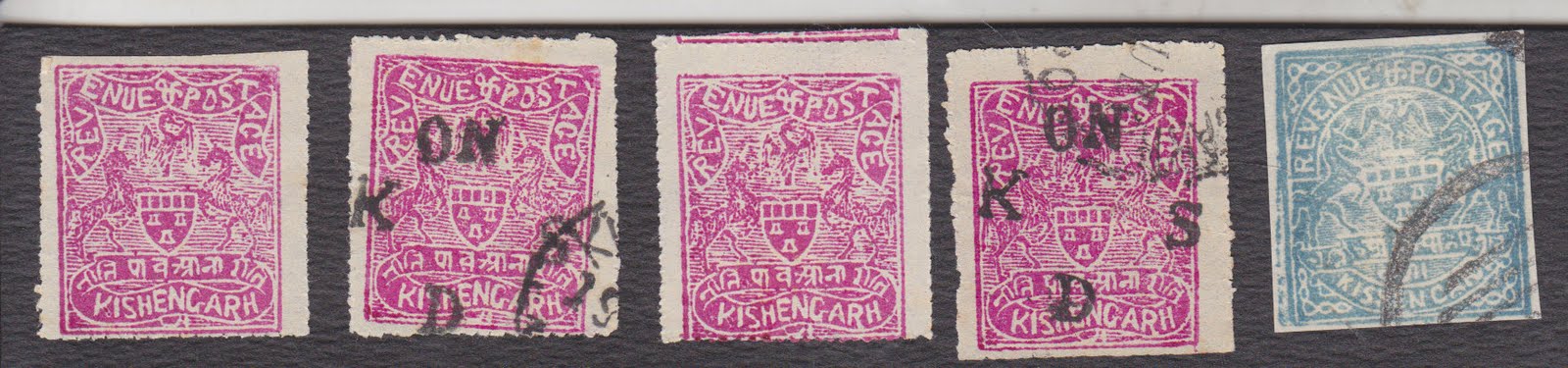
The illustration below shows some early postage stamps from Kishangarh (on the stamp spelt Kishengarh ). The design shows the Kishangarh State emblems. the stamps were issued without perforations. Two of the stamps show an interesting variation in that the K of Kishengarh has lost the lower part of the K. One shows a remnant of the stamp above it as they were issued as "tete beche" pairs ( head to tail ). Two are overprinted for official use. The values are a quarter anna for the rose/pink and half anna for the blue.
Some Interesting Overprints on Early British postage Stamps
A small range of stamps showing varieties of overprints now no longer used on British stamps. (To enlarge the illustration, click on it then back page to return to the blog).Two of the Edward the 8th Morrocan Agencies overprints show an interesting error in not having the values changed to local currency.
Some early Stamps of Indian Convention States
The stamps of Indian Convention States were stamps that had currency throughout British India with the name of the individual state overprinted on the stamp. There was some variety in the overprints in the early stamps. For example Patiala State was originally printed as Puttialla State in red as a "halo" around the head of Victoria. When the word "service" was overprinted on earlier stamps it appeared in red, later in black with some printed in smaller letters others in larger and in different areas of the stamp. Some examples are shown below. The half anna, second from the left on the bottom row, shows an error in the printing of Puttialla, being printed as Auttialla. These varieties did not last as the printing became standardized and by the late reign of Victoria and the accession of Edward the 7th these varieties had disappeared.
Illustration 2 shows the now standardized overprint on stamps of Edward the 7th. With an interesting new overprint of "telephone service" now in use
Subscribe to:
Posts (Atom)